
Word Search vs. Sudoku for Seniors: Which Puzzle Fits You Better?
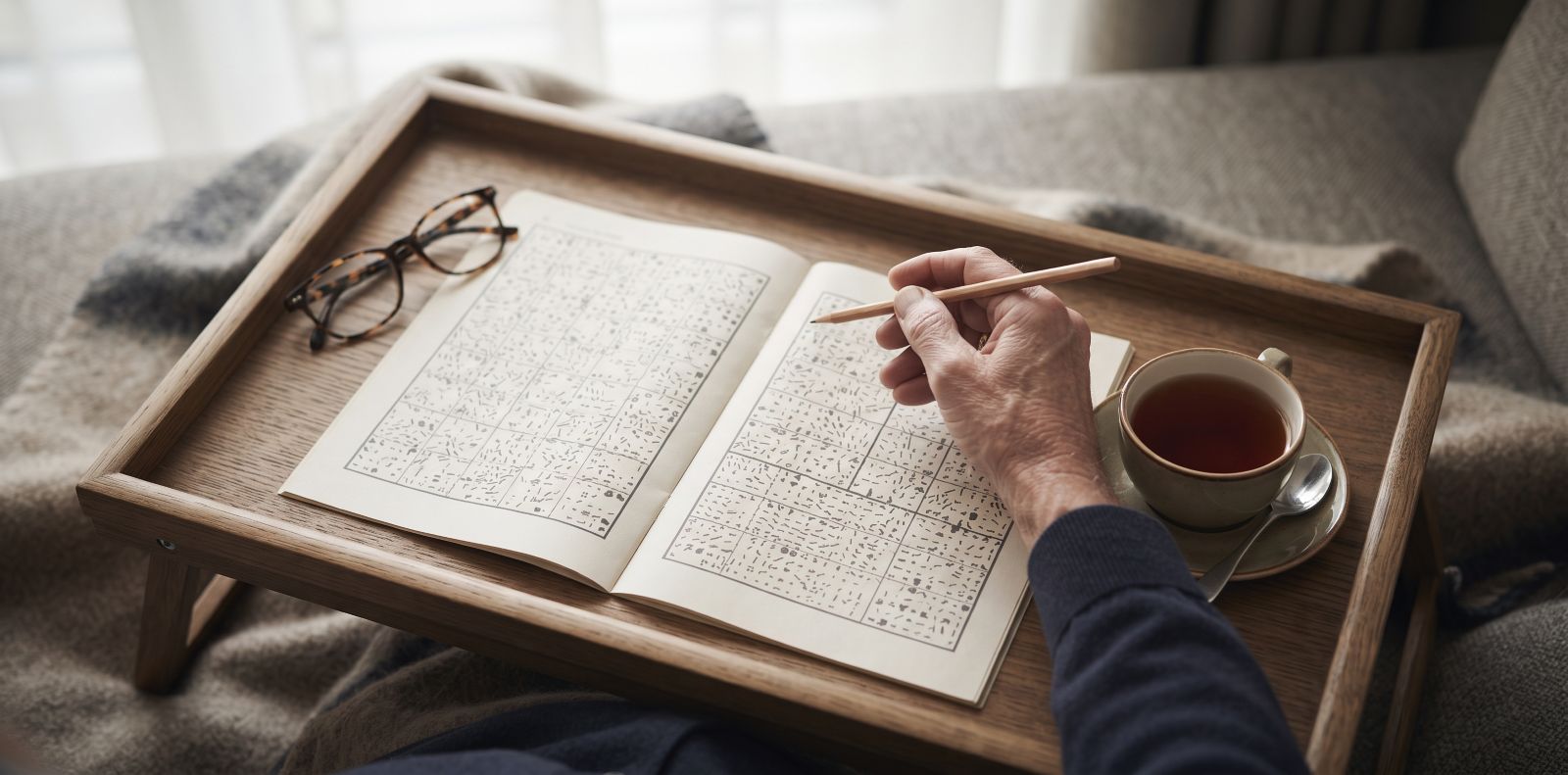
Quick answer: Choose a word search if you enjoy words, memories and a relaxed, scanning kind of focus. Choose Sudoku if you like quiet, step-by-step logic. Neither needs math skills: Sudoku uses the digits 1 to 9 as symbols, not for arithmetic, and a word search only asks you to find hidden words. Both are enjoyable pastimes, so the best puzzle is the one you will actually want to pick up again tomorrow. Many people keep one of each on the table.
What each puzzle asks of you
A word search is a grid of letters with words hidden in it. Words can run across, down or diagonally, and often backwards too. Most come with a word list, though harder ones leave it out, and many are built around a theme such as food, animals or colors. The usual tricks are to look for the first letter of a word, or for unusual letters such as Q, J, X or Z.
Sudoku is a 9×9 grid that is partly filled in. Your job is to fill the empty squares so that every row, every column and every one of the nine 3×3 boxes contains the digits 1 to 9 once. A well-made Sudoku has exactly one solution. The modern puzzle is a game of logic, not calculation, and the name comes from Japanese, roughly meaning “single number.”
Word search vs. Sudoku at a glance
| Word search | Sudoku | |
|---|---|---|
| What you do | Spot hidden words in a grid of letters | Place digits 1 to 9 following three rules |
| Uses | Reading, scanning, vocabulary | Logic, patience, careful checking |
| Math needed? | None | None (digits are just symbols) |
| Typical feel | Relaxed and browsing | Quiet and concentrated |
| Themes | Often themed (food, places, memories) | Usually plain digits |
| Good when | You want a gentle, sociable puzzle | You like working something out alone |
| Can be frustrating when | The grid is small or crowded | A square gets filled in wrongly early on |
| Easy to adjust? | Yes: choose shorter lists and bigger print | Yes: choose easier puzzles with more digits given |
How to choose: a few simple questions
- Do you enjoy reading and crosswords? A word search is probably a comfortable start.
- Do you like a puzzle with clear rules and one right answer? Try Sudoku.
- Is eyesight a concern? Look at the print size first. Large-print editions of both puzzles exist, and in either case a pencil with an eraser is kinder than a pen.
- Do you want something to share? A word search is easy to do together, because two people can search the same grid.
- Do you get frustrated quickly? Start with an easy level of either puzzle. A puzzle that is too hard stops being fun.
If you are choosing for a parent, our guide on how to choose the right puzzle book for aging parents goes through print size, difficulty and themes in more detail.
What do we actually know about puzzles and the brain?
It is natural to wonder whether puzzles are “good for the brain.” The honest answer is that the evidence is mixed. A National Geographic article that looked at the research reports that studies have found links between doing puzzles and better reasoning, memory and language skills, but that these links do not show that puzzles cause the benefit. People who do puzzles may also be more social, better educated or more physically active. The same article notes that regular physical exercise is far better documented for supporting thinking skills, and that doing the same puzzle in the same way over and over may add little. One expert quoted says a puzzle works best when it is challenging enough to keep you thinking.
That is a good reason to enjoy puzzles for what they are, a pleasant way to spend a quiet half hour, and to mix them up. Trying a word search one day and a Sudoku the next gives you variety without any promises about outcomes. This article is not medical advice, and puzzles do not diagnose, treat or prevent any condition.
Getting started: five easy tips
- Pick the print size first. Large, clear type makes both puzzles more relaxed.
- Use a pencil. Mistakes are normal, especially in Sudoku.
- Start easy. Finishing a first puzzle feels good and makes you want another.
- Keep sessions short. Ten to fifteen minutes is plenty. This is our suggestion, not a rule.
- Alternate. One word search and one Sudoku a week keeps things fresh.
A puzzle book to match
Sharp Mind is a recreational puzzle and memory series for adults 60+. Its six kinds of exercise include word searches, true-or-false questions, proverbs and memory pages, all in large, easy-to-read type with every solution printed at the back of the book. Vol. 3: Memory and Focus Exercises is the basic-training volume with 150 pages, and Vol. 1: With a Touch of Nostalgia is built around memories. The series is meant for enjoyment and makes no treatment claims. You can look at the whole Sharp Mind series and try sample pages in our free samples.
Disclosure: Alex Herek is the publisher of these books. You can find all titles on the Amazon author page.
Frequently asked questions
Is Sudoku harder than a word search? Not necessarily. Both come in easy and hard versions. Sudoku follows strict rules and can feel more demanding if you do not enjoy logic, while a word search is more forgiving but can be tiring when the grid is crowded or the print is small.
Do I need to be good at math to do Sudoku? No. The digits in a Sudoku are only symbols. You never add or multiply them. The puzzle is solved with logic.
Which is better for relaxing in the evening? Many people find a themed word search the more relaxed choice, because you can browse and enjoy finding words. Others find the quiet focus of Sudoku calming. Try both and see.
Do puzzles prevent memory problems? No one can promise that. Research on puzzles and thinking skills is mixed, and it mostly shows links, not proof of cause. Puzzles are best enjoyed as a pleasant pastime. If you have concerns about memory, please talk to your doctor.
What should I do if a puzzle feels too hard? Switch to an easier level, use bigger print, take a break, or try the other puzzle type. A puzzle should leave you satisfied, not frustrated.
Key takeaways
- Word search suits readers who like a relaxed, scanning kind of focus; Sudoku suits people who enjoy quiet logic.
- Neither needs math: Sudoku uses digits as symbols only.
- The research on puzzles and thinking skills is mixed, so enjoy puzzles as a pastime, not a promise.
- Print size and difficulty matter more than the puzzle type, and alternating the two adds variety.
Sources
- Sudoku, Wikipedia (rules of the 9×9 grid, one-solution puzzles, logic rather than arithmetic, origin of the name).
- Word search, Wikipedia (hidden words in a letter grid, directions, word lists, themed puzzles, search strategies).
- Do crossword puzzles really keep your brain sharp?, National Geographic (mixed evidence on puzzles and brain health, correlation versus causation, exercise, difficulty and novelty).
Haven't tried the series yet?
Grab a free sample from Left Hand Brain Training for Seniors.