
Mirror Drawing Exercises: A Simple Way to Challenge Hand-Eye Coordination
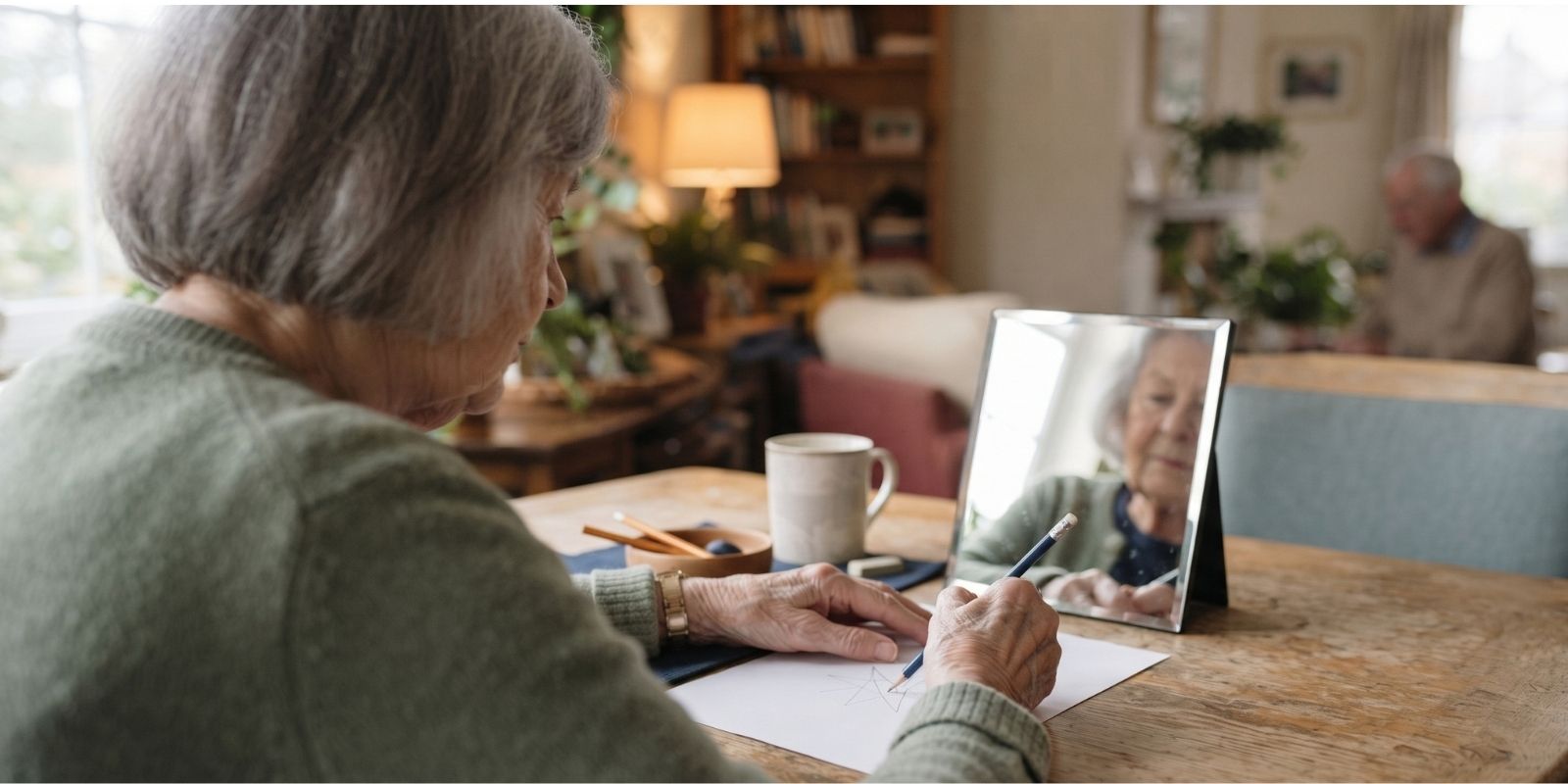
Quick answer: Mirror drawing is the practice of copying a shape or line while looking only at its mirrored reflection — a simple exercise that briefly confuses the connection between what your eye sees and what your hand does. That small disconnect is exactly what makes it an engaging hand-eye coordination challenge, and a genuinely fun one to get better at with practice.
What mirror drawing actually involves
In a classic mirror drawing setup, a shape — a star, a spiral, a simple maze — is placed so you can only see it reflected in a mirror, not directly. You then try to trace or copy it while watching the mirror image instead of the page itself. Every instinct about “left” and “right” gets flipped, so a line you’d normally draw without thinking suddenly takes real concentration.
It’s a well-known exercise in hand-eye coordination research precisely because it’s so immediately disorienting — and just as quickly, oddly satisfying once the hand starts adjusting.
Why it feels so strange at first
Normally, your eyes and hands work on the same map: you see where a line needs to go, and your hand goes there. Mirror drawing breaks that map. The reflection reverses left and right, so a line that should go right now appears to go left in the mirror — and your hand, trained over a lifetime to trust what it sees, has to unlearn that instinct one stroke at a time.
That’s the whole appeal. It isn’t about getting it right immediately; it’s about watching your coordination adjust, attempt by attempt, to a task that briefly scrambles a connection you normally never think about.
At a glance
- Mirror drawing means copying a shape while looking only at its mirror image, not the shape directly.
- It briefly reverses the usual link between what the eye sees and what the hand does.
- Most people find it noticeably easier after a handful of attempts — a fast, visible kind of practice.
- It works well as a short, puzzle-like activity, not a long session.
- This is a recreational coordination challenge, not a medical or diagnostic exercise.
How to try it yourself
1. Set up a simple mirror and shape
Prop a small hand mirror upright behind a sheet of paper, angled so you can see the paper’s reflection but not the paper itself when you look at the mirror. A printed star, spiral, or simple maze works well as a starting shape.
2. Trace while watching only the mirror
Keep your eyes on the mirror the entire time, and try to trace the shape’s outline on the page without looking down at your hand directly. Expect the first few lines to go the “wrong” way — that’s the exercise working as intended.
3. Start with simple, forgiving shapes
A five-pointed star or a wide, open spiral gives you room to adjust mid-line. Save tighter, more detailed shapes for once the basic reversal starts to feel more natural.
4. Keep sessions short
Five to ten minutes is usually enough — mirror drawing asks for intense, focused attention, and it tends to feel like more work than other fine motor drills for the same amount of time.
5. Track how quickly it clicks
Most people notice a real shift within the same session — the first attempt is often the most disorienting, and later attempts at the same shape tend to go noticeably smoother, which is part of what makes this exercise satisfying to repeat.
Mirror drawing vs. regular tracing
| Regular tracing | Mirror drawing | |
|---|---|---|
| Eye-hand connection | Direct — see it, draw it | Reversed — hand must work against instinct |
| Difficulty curve | Fairly flat | Steep at first, flattens quickly with practice |
| Sense of challenge | Low, familiar | High initially, drops fast within a session |
| Best session length | Any length | Short (5–10 minutes) — it’s mentally demanding |
| Novelty | Minimal | High — genuinely unfamiliar coordination task |
Pairing it with other hand exercises
Mirror drawing sits naturally alongside other fine motor and coordination habits — it’s a short, focused challenge rather than an everyday warm-up. Many people use it as an occasional change of pace from steadier practices like daily tracing drills or non-dominant hand drawing, which build coordination more gradually. Left Hand Brain Training for Seniors moves through a similar arc across its five books, starting with straightforward lines and shapes and building toward more challenging exercises like mirror-image drawing later in the series.
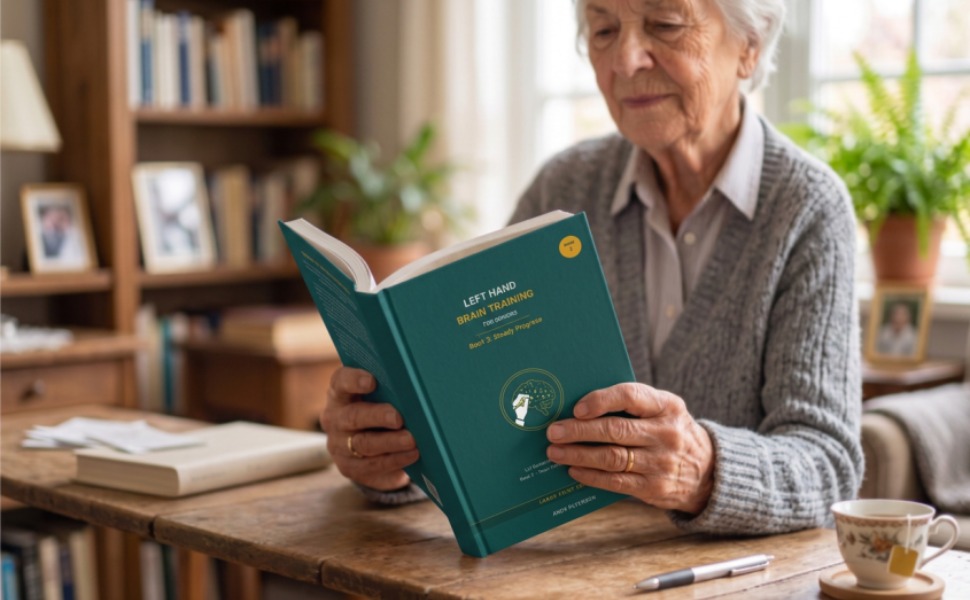
Try it yourself: download a free sample page to see how a guided, large-print exercise feels before picking up the full series.
Frequently asked questions
Do I need a special mirror for this? No. Any small, flat hand mirror that can be propped upright works. The key is positioning it so you see the shape’s reflection but not the shape directly.
Is mirror drawing a medical or diagnostic test? No. While researchers sometimes use mirror drawing tasks in coordination studies, the version here is a recreational brain-fitness activity, not a medical or diagnostic exercise. It doesn’t diagnose, treat, or prevent any condition.
Why does it feel so much harder than regular drawing? Because your hand is trained to trust what your eyes see directly, and the mirror reverses that relationship. The disorientation is temporary and is the whole point of the exercise.
How long until it starts to feel easier? Many people notice real improvement within the same session, often after just a handful of attempts at the same shape. Longer-term comfort tends to build with occasional, repeated practice rather than daily drilling.
What’s a good next step after trying mirror drawing? Non-dominant hand drawing is a related but steadier challenge — see Non-Dominant Hand Drawing: How Neuroplasticity-Inspired Exercises Support Brain Fitness and the Left Hand Brain Training series, which builds toward mirror-image drawing gradually across its five books.
Haven't tried the series yet?
Grab a free sample from Left Hand Brain Training for Seniors.